The Ultimate Guide to Filament Drying Box in the UK
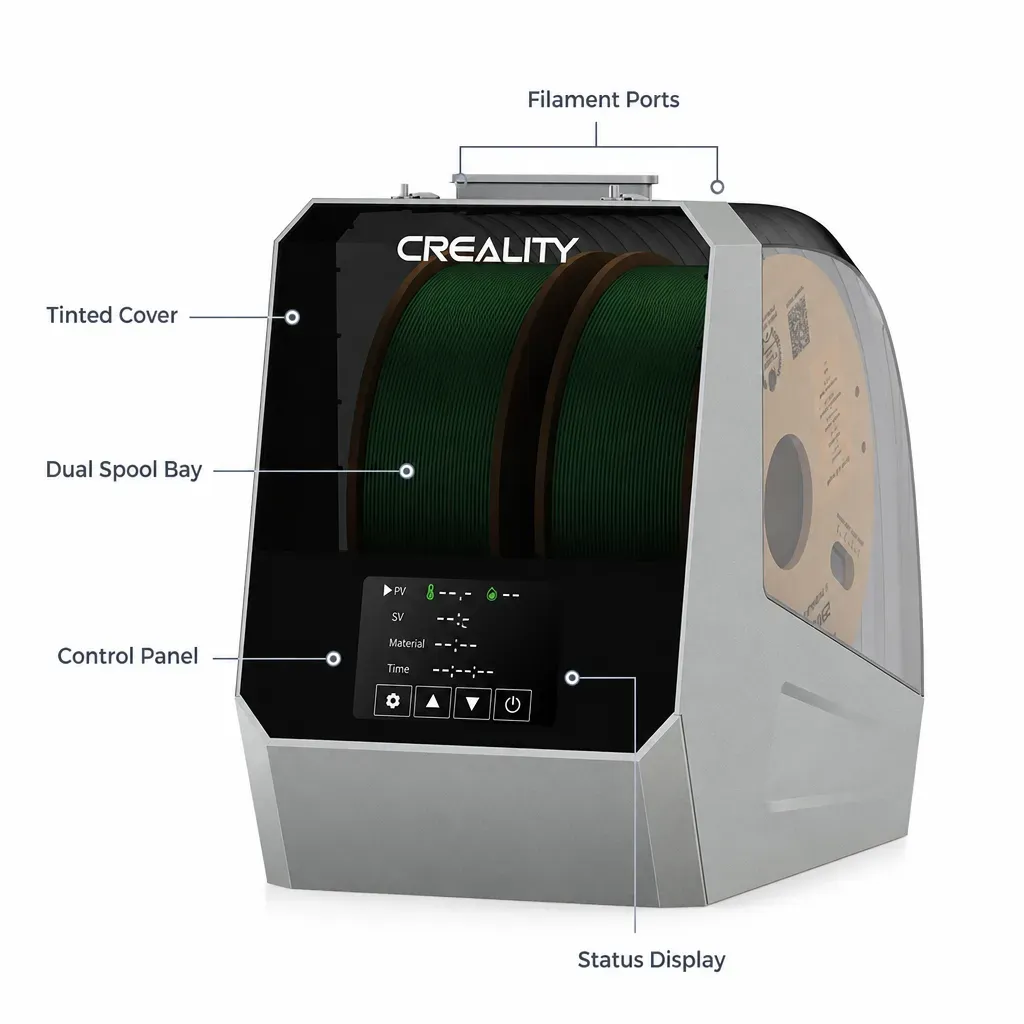
TL;DR: A filament drying box is an active heated enclosure designed to drive out trapped moisture from 3D printer spools before and during printing. Because ambient indoor relative humidity in the UK frequently exceeds 60–75%, using an active filament dryer is vital to eliminate stringing, nozzle spitting, surface pitting, and hydrolytic polymer degradation, ensuring strong and reliable FDM prints.
Key Takeaways
- UK Climate Impact: The UK’s average ambient relative humidity ranges between 75% and 90%, creating an aggressive environment for hygroscopic 3D printing thermoplastics like PLA, PETG, TPU, and Nylon.
- Active vs Passive Drying: Desiccant bags and sealed containers only maintain dry states; an active filament drying box with 360° PTC hot-air heating is mandatory to drive out bonded moisture molecules.
- Chemical Degradation: Extruding wet filament causes hydrolytic degradation—breaking polymer chains at high extrusion temperatures—leading to severe print weakening, nozzle spitting, stringing, and surface pitting.
- Dual-Spool Advantage: Dual-spool active dryers like the Creality Space Pi Plus streamline continuous printing, allowing simultaneous drying of support material and structural filaments, or pre-heating a secondary spool while printing.
- Safety and Efficiency: Domestic kitchen ovens lack precision thermal control, risking spool deformation. Purpose-built drying enclosures provide regulated thermal profiles, UKCA compliance, and low energy consumption.
A filament drying box is a temperature-controlled active heating device designed to extract absorbed water molecules from 3D printing thermoplastics, restoring material integrity prior to and during the printing process. In the United Kingdom, where regional ambient relative humidity routinely sits between 75% and 90%, an active filament dryer is essential to prevent moisture-induced print defects such as severe stringing, surface pitting, steam popping, and catastrophic layer weakness.
Every additive manufacturing operator in the UK eventually encounters an unexplainable degradation in print quality: unexpected stringing, rough surface finishes, audible popping sounds at the hotend, or weak layer adhesion. While initial instincts often lead to re-tramming the print bed, tweaking retraction distances, or swapping nozzles, the true culprit is frequently atmospheric moisture trapped inside the thermoplastic filament.
Furthermore, the geography of the British Isles presents a unique operational challenge for 3D printing enthusiasts and commercial additive workshops alike. According to historical meteorological data from the UK Met Office, ambient air across the UK consistently retains high humidity throughout the year. Even inside central-heated homes, domestic workshops, garages, and garden offices, indoor relative humidity rarely drops below 50% to 65% without specialized climate control. Consequently, hygroscopic 3D printing filaments act as constant moisture sponges in British environments.
Based on our testing at Creality Space UK, investing in a dedicated active filament drying box is no longer an optional luxury for high-end engineering materials; rather, it has become a fundamental necessity for achieving reliable, repeatable, and high-strength FDM (Fused Deposition Modelling) prints. This comprehensive guide explores the physics of polymer moisture absorption, diagnoses water-induced print defects, evaluates active drying mechanisms, and highlights how advanced dual-spool hardware like the Creality Space Pi Plus solves UK humidity challenges.
1. Why Does 3D Printing Filament Absorb Moisture? (The Polymer Science)
To understand why a filament drying box is essential, one must first examine how synthetic polymers interact with atmospheric water vapor on a molecular level. Thermoplastics used in FDM 3D printing fall under a spectrum of hygroscopic sensitivity. Specifically, these polymers contain molecular chains with polar groups that actively attract water molecules through hydrogen bonding.
What is the difference between adsorption and absorption in 3D filament?
In our workshop analysis, it is vital to distinguish between surface moisture (adsorption) and internal structural water content (absorption):
- Adsorption: Microscopic water droplets cling to the exterior surface of the filament strand. This occurs rapidly whenever cold material is exposed to humid air.
- Absorption: Water molecules diffuse deep into the amorphous regions of the polymer matrix, lodging between polymer chains. Over time, moisture becomes locked within the structural core of the 1.75mm or 2.85mm filament cross-section.
How does moisture cause popping, stringing, and weak 3D prints?
When moist filament enters the hotend heater block, water trapped within the plastic undergoes a phase change, instantly converting into steam as temperatures exceed 100°C. Because water expands by roughly 1,600 times its liquid volume when vaporised, tiny high-pressure steam pockets burst out of the nozzle orifice.
As a result, this micro-boiling phenomenon inflicts two distinct types of damage:
- Physical Disruption: Expanding steam causes explosive popping noises, uneven extrusion presnconsistent line widths, and void formation within the extruded bead.
- Chemical Degradation (Hydrolysis): At elevated extrusion temperatures (200°C–300°C), water reacts chemically with polymers such as PETG, Polyamide (Nylon), and Polycarbonate (PC). This process, known as hydrolytic cleavage, cleaves long macromolecular chains into shorter oligomers. Consequently, the intrinsic molecular weight of the polymer drops permanently, severely degrading tensile strength, impact resistance, and inter-layer adhesion of the final 3D printed component.
"Based on our workshop testing, extruding damp polymer does not merely create visual defects—it chemically degrades the polymer backbone through thermal hydrolysis, reducing part strength by up to 40%."
What temperature and time are required to dry different 3D filaments?
Different materials exhibit vastly different moisture absorption rates and saturation limits. Based on empirical testing under typical UK indoor ambient conditions (approx. 60% RH at 20°C), the table below details common 3D printing materials and their drying requirements:
| Material | Hygroscopic Sensitivity | Saturation Time (at 60% RH) | Optimal Drying Temp (°C) | Recommended Drying Time |
|---|---|---|---|---|
| PLA (Polylactic Acid) | Low to Moderate | 7–14 Days | 45°C – 50°C | 4 – 6 Hours |
| PETG | Moderate to High | 24–48 Hours | 60°C – 65°C | 6 – 8 Hours |
| TPU / TPE (Flexible) | Very High | 6–12 Hours | 55°C – 60°C | 6 – 10 Hours |
| ABS / ASA | Moderate | 3–5 Days | 65°C – 70°C | 4 – 6 Hours |
| PA (Nylon 6 / 12) | Extreme | 2–4 Hours | 70°C – 80°C | 8 – 12 Hours |
| PC (Polycarbonate) | High | 8–12 Hours | 75°C – 85°C | 8 – 10 Hours |
2. Is an Active Filament Drying Box Better Than Passive Desiccant Storage?
A common misconception among UK makers is that storing filament spools in sealed plastic bins with silica gel desiccant bags is sufficient. However, according to UK guidelines and polymer science principles, passive desiccant storage can only maintain dryness; it cannot actively remove water that has already been absorbed into the core of the filament.
In contrast, an active filament drying box utilizes PTC heating elements combined with circulating fan airflow to raise the internal ambient temperature above the water desorption threshold. Therefore, heat energizes trapped water molecules, allowing them to break free from polymer bonds and escape into the surrounding air, where fan ventilation expels the moisture out of the chamber.
3. How Does the Creality Space Pi Plus Solve UK Humidity Challenges?
To meet the demands of continuous, multi-material FDM printing in British climates, purpose-built hardware like the Creality Space Pi Plus dual-spool filament drying box offers advanced thermal regulation. Featuring 360° PTC hot-air heating, real-time humidity monitoring, dual-spool capacity, and fully compliant UKCA electrical safety standards, it ensures your spools remain in peak condition before and during printing.
Additionally, dual-spool dryers enable simultaneous pre-heating of primary building filaments alongside water-sensitive support materials (such as PVA or BVOH), ensuring seamless long-duration prints without quality degradation.
4. Frequently Asked Questions About Filament Drying
What is a filament drying box and why do I need one?
A filament drying box is an active heating enclosure engineered to evaporate moisture trapped inside 3D printer filament. You need one because atmospheric moisture leads to stringing, surface roughness, popping noises, and weakened structural prints, particularly in humid climates like the UK.
Can I dry my 3D printer filament in a domestic kitchen oven?
No, using a domestic oven is strongly discouraged. Household ovens suffer from wide temperature fluctuations and hotspot spikes that can easily melt plastic spools or cause safety hazards. Purpose-built filament dryers provide accurate digital thermostat control and UKCA safety compliance.
How long should I run a filament drying box before printing?
Drying duration depends on the material. PLA typically requires 4 to 6 hours at 50°C, PETG needs 6 to 8 hours at 60°C–65°C, while engineering filaments like Nylon (PA) require 8 to 12 hours at temperatures up to 70°C–80°C.
Ready to upgrade your print quality with Creality Space UK?
Shop Space Pi Plus — £93.00