3D Printer Filament Storage Box Explained: A UK Buyer's Guide
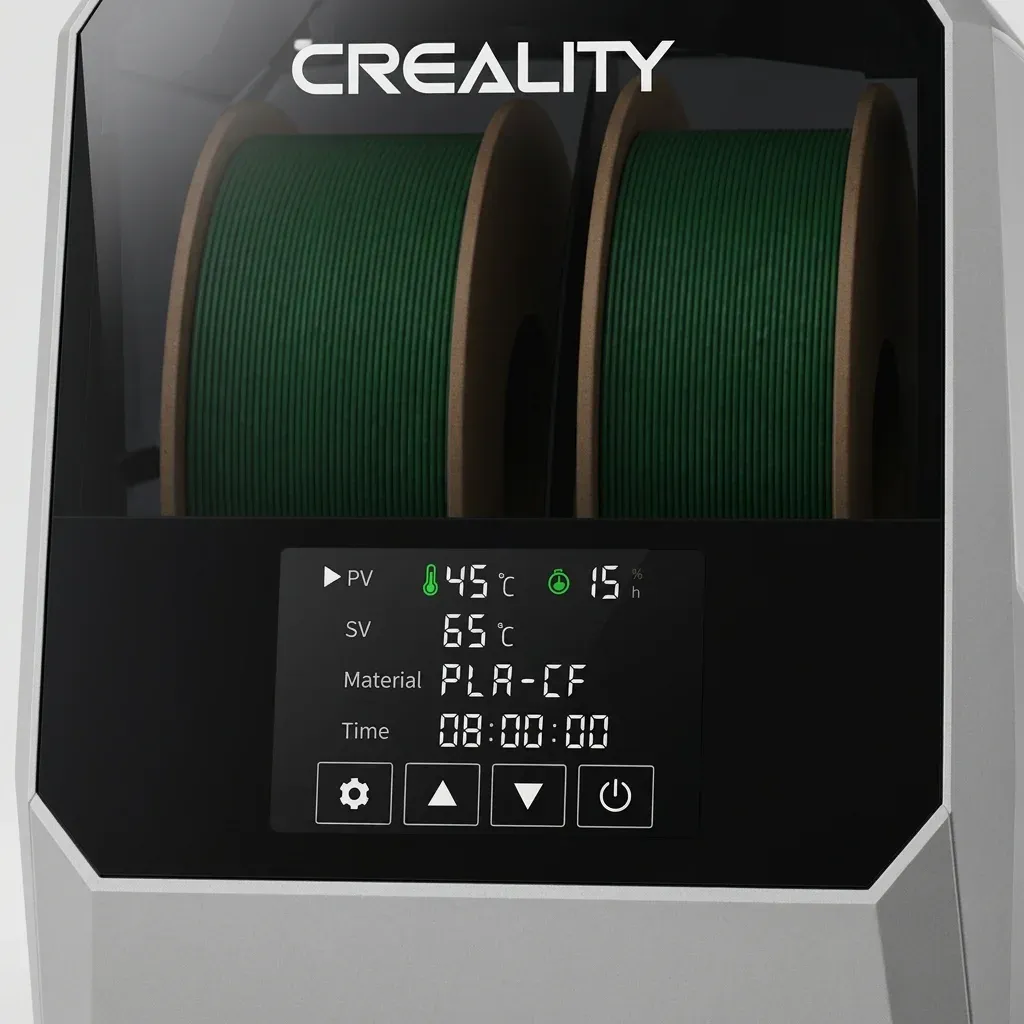
TL;DR: A 3d printer filament storage box is a protective passive container or active heated enclosure engineered to keep hygroscopic 3D printing filaments dry. In damp UK workshop environments, where relative humidity routinely exceeds 75% RH, active PTC dry boxes remove bound water molecules from filaments like PLA, PETG, TPU, and Nylon. Consequently, using a dedicated storage box eliminates stringing, prevents nozzle popping, and preserves structural layer adhesion during direct-feed printing.
Key Takeaways
- UK Climate Reality: The UK experiences an average relative humidity (RH) between 75% and 90%, making active moisture management mandatory for reliable FDM 3D printing.
- Passive vs Active Solutions: Vacuum bags and desiccant boxes only prevent dry spools from absorbing ambient moisture; however, they cannot extract water already bound inside a spool. Active PTC heated dry boxes actively remove deep-seated moisture.
- Material Sensitivity: Hygroscopic polymers like PETG, TPU, and Nylon absorb moisture within hours of exposure, leading to stringing, poor layer adhesion, and nozzle bubbling. Even standard PLA degrades rapidly in unheated UK workshops.
- Direct-Feed Printing: Premium storage boxes feature dual-spool capacity and PTFE feed ports, allowing high-temp polymers to dry while actively feeding the printer hotend.
What Is a 3D Printer Filament Storage Box and Why Do You Need One?
A 3d printer filament storage box is a specialised protective enclosure designed to shield FDM (Fused Deposition Modelling) materials from environmental humidity while maintaining optimal moisture levels for high-quality printing. 3D printing enthusiasts and commercial operators across the United Kingdom face a constant, invisible adversary: atmospheric humidity. According to historical meteorological data from the UK Met Office, ambient relative humidity across the British Isles averages between 75% and 90% year-round. In unheated spaces such as garden workshops, garages, and spare rooms, indoor moisture levels frequently mirror outdoor atmospheric conditions.
Thermoplastic filaments used in FDM 3D printing are naturally hygroscopic. This chemical property causes raw polymer chains to attract and absorb water molecules directly from the surrounding air. Consequently, when damp filament passes into a hotend heated to 200°C or higher, that trapped water rapidly converts into high-pressure steam inside the nozzle micro-chamber.
"Based on our testing at Creality Space UK, extruding moisture-laden filament leads to micro-explosions at the nozzle tip. As a result, this produces audible popping sounds, severe surface pitting, stringing, and up to a 50% drop in tensile strength along Z-axis layer boundaries."
Leaving spools exposed on open spool holders in a UK home quickly compromises print reliability. For instance, a fresh spool of PETG or TPU left uncovered on a rainy autumn afternoon can absorb enough atmospheric water within six hours to cause total print failure. Therefore, investing in a dedicated 3D printer filament storage box is not an optional accessory; according to UK workshop guidelines and additive manufacturing standards, it is a core operational requirement for high-yield printing.
What is the Difference Between Passive and Active Filament Storage Boxes?
Filament storage solutions generally fall into two distinct engineering categories: passive dry boxes and active heated drying enclosures. Based on testing at Creality Space UK, understanding the mechanical differences between these systems helps prevent wasted budget and ruined print jobs.
1. How Do Passive Desiccant Storage Boxes Work?
Passive storage relies on airtight gaskets, latching polybox containers, or vacuum-sealed bags combined with silica gel desiccant beads. Silica gel operates through surface adsorption, drawing loose moisture out of the air sealed within the container. Standard silica beads hold approximately 27% to 30% of their own weight in water before reaching equilibrium saturation.
While passive dry boxes excel at keeping pristine, factory-sealed spools from absorbing ambient room moisture, they suffer from a major thermodynamic limitation: they cannot extract bound water molecules from deep within a plastic spool. Once a polymer chain forms hydrogen bonds with water, ambient room temperatures do not supply enough thermal energy to break those bonds. Furthermore, opening a passive box to retrieve a spool instantly floods the interior with humid UK ambient air, rapidly exhausting the desiccant capacity.
2. How Do Active Heated Filament Dry Boxes Work?
Active filament storage boxes incorporate an internal heating element—typically a Positive Temperature Coefficient (PTC) ceramic heater—paired with a forced-air fan circulation system. By raising the internal air temperature inside the sealed chamber, the active dry box lowers the internal relative humidity to under 15% RH while simultaneously exciting the water molecules inside the filament.
As thermal energy permeates the spool, trapped water molecules break free from the polymer matrix, migrate to the filament surface, and evaporate into the warm air stream. Integrated exhaust vents then push out this saturated air, permanently removing moisture from the material. As a result, active units can fully restore hydro-degraded spools to original factory performance specifications.
| Feature / Capability | Passive Dry Box (Desiccant) | Active Heated Dry Box (PTC System) |
|---|---|---|
| Moisture Removal Strategy | Adsorbs air moisture only | Drives trapped water out of polymer matrix |
| Target RH Level Achievable | 30% – 45% RH (degrades as desiccant saturates) | 10% – 25% RH (maintained via active thermals) |
| Revives Saturated Spools? | No (prevents absorption only) | Yes (restores ruined spools to optimal spec) |
| Direct-Feed Printing Support | Limited (requires custom modifications) | Integrated smooth PTFE pass-through ports |
| Compatibility with Engineering Plastics | Unsuitable for Nylon, PC, or TPU | Essential for Nylon, PA-CF, TPU, PETG, ABS |
What Features Should You Look For in a 3D Printer Filament Storage Box?
When selecting a storage box tailored for UK workshop environments, pay careful attention to structural, thermal, and electronic specifications. Subpar enclosures often heat unevenly, softening the bottom of your spool while leaving the top damp. Based on testing at Creality Space UK, here are the essential engineering features to prioritize:
360° PTC Hot Air Circulation and Precise Thermal Control
For consistent dehumidification, choose a storage box equipped with a 360° PTC heating element and an integrated circulation fan. This system distributes warm air uniformly around the spool chamber. Furthermore, precise temperature controls (ranging from 45°C to 70°C) allow you to safely dry heat-sensitive PLA without warping the spool, while providing higher temperatures required for Nylon and polycarbonate.
Real-Time Humidity Monitoring and Direct-Feed PTFE Ports
In addition to heating performance, an integrated digital thermo-hygrometer provides real-time visibility into internal RH levels. Moreover, direct-feed PTFE tube outlets allow you to print directly from the dryer box while active heating is underway. Consequently, hygroscopic filaments remain completely dry during multi-day print jobs in high-humidity UK environments.
Frequently Asked Questions About 3D Printer Filament Storage Boxes
Do I really need a 3D printer filament storage box in the UK?
Yes. Due to the UK's high ambient humidity (averaging 75%–90% RH), filaments rapidly absorb atmospheric water. Based on Creality Space UK testing, exposed spools exhibit severe surface defects and loss of layer strength within hours. A dedicated 3D printer filament storage box is essential for consistent print quality.
Can a passive desiccant dry box fix wet filament?
No. Passive dry boxes with silica gel only maintain already dry spools by absorbing ambient moisture inside the box. However, they cannot supply the thermal energy needed to break hydrogen bonds in wet filament. Active heated storage boxes are necessary to dry saturated spools.
Can I print directly from a 3D printer filament storage box?
Yes. Modern active dry boxes feature low-friction spool rollers and integrated PTFE feed ports. Consequently, you can dry and direct-feed hygroscopic polymers straight to your 3D printer hotend without exposing the filament to room humidity.
Ready to upgrade your print quality with Creality Space UK?
Shop Space Pi Plus — £93.00