Pla Petg Filament Dryer Explained: A UK Buyer's Guide
TL;DR: A PLA PETG filament dryer is an active heating device that extracts bound atmospheric moisture from 3D printing spools. In the UK's humid climate (75%–90% outdoor RH), both PLA and PETG rapidly absorb water vapour, causing severe stringing, nozzle popping, and weak Z-axis layer adhesion. Active 360° PTC hot-air drying safely dehydrates PLA at 45°C–50°C and PETG at 60°C–65°C while venting moist air, fully restoring print quality and tensile strength.
A PLA PETG filament dryer is a specialized thermal device engineered to remove trapped moisture from PLA (Polylactic Acid) and PETG (Polyethylene Terephthalate Glycol) 3D printer filaments. Due to high ambient atmospheric humidity across the British Isles, moisture quickly penetrates stored spools, leading to severe extrusion flaws, steam popping, and structural failure. Active 360° PTC thermal drying effectively dehydrates polymer matrices, restoring baseline print fidelity and layer strength.
Key Takeaways
- UK Climate Impact: Average UK relative humidity (75%–90% outdoors; 50%–70% indoors) causes rapid moisture uptake in PLA and PETG, leading to bubbling, stringing, and weak layer bonds.
- Active vs Passive Drying: Desiccant dry boxes only keep dry filament dry; however, they cannot extract moisture bound inside polymer chains. Active 360° PTC hot air drying is required to rehabilitate wet spools.
- Temperature Control is Critical: Based on our testing at Creality Space UK, PLA must be dried below its glass transition temperature (45°C–50°C), whereas PETG requires higher temperatures (60°C–65°C) to release bound water without fusing the spool.
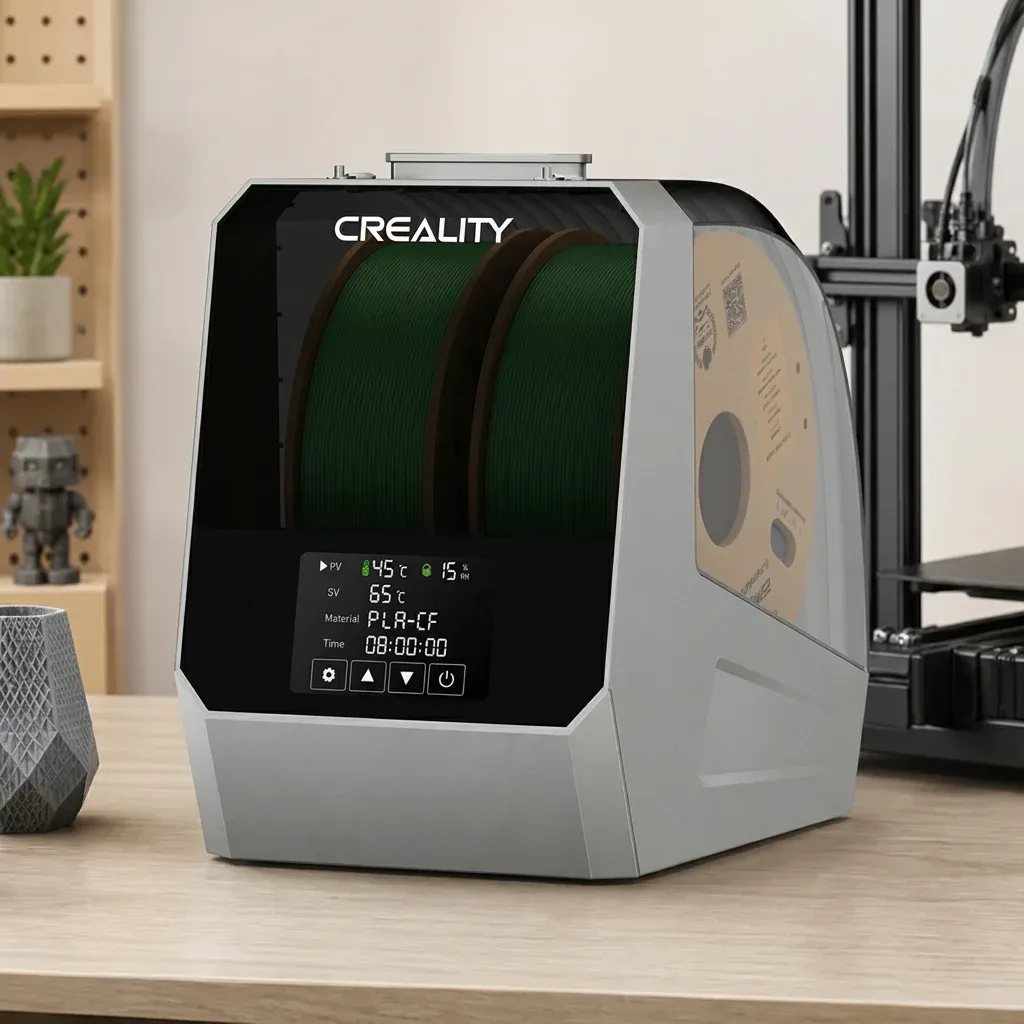
- Dual-Spool Advantage: Dual spool active dryers like the Creality Space Pi Plus enable continuous multi-material printing and batch pre-drying, saving energy and reducing job setup times.
Why Does UK Ambient Moisture Destroy 3D Prints?
3D printing enthusiasts and commercial operators across the United Kingdom face a persistent, invisible challenge: atmospheric moisture. Whether operating a printer in a home office in Surrey, a basement garage in Manchester, or a workshop in the Scottish Highlands, the ambient climate presents a constant hazard to thermoplastic filaments.
According to official UK Met Office climate data, the average annual relative humidity (RH) across the British Isles routinely stays between 75% and 90%. Furthermore, even inside central-heated residential properties or insulated workshops, ambient humidity rarely drops below 50% to 60% RH without dedicated dehumidification. For hygroscopic materials—polymers that actively draw water vapour from the surrounding atmosphere—this damp environment leads directly to print failure.
Consequently, when a roll of PLA or PETG sits exposed on a spool holder, water molecules penetrate the outer shell of the filament strand. During extrusion, this trapped water reaches the hotend heater block at temperatures between 200°C and 260°C. The trapped liquid instantly flashes into steam, expanding inside the nozzle cavity by roughly 1,600 times its original liquid volume. As a result, this sudden phase change creates tiny steam explosions inside the melt zone, producing distinct cracking or popping sounds during printing.
"Based on our testing at Creality Space UK, extruding moisture-laden filament turns your hotend into a micro-steam engine. The resulting pressure fluctuations destroy flow control, creating internal voids, severe stringing, and up to a 40% loss in Z-axis tensile strength."
The visible evidence of wet filament goes far beyond surface cosmetic defects. Hydrolysis occurs when water molecules react with hot polymer chains under thermal stress, breaking down the molecular weight of the plastic. The table below highlights the physical symptoms of moisture contamination in common filaments:
| Material | Hygroscopic Rate | Visual Symptoms | Structural Consequence |
|---|---|---|---|
| PLA (Polylactic Acid) | Moderate (2–5 days to saturate) | Brittle filament breakage, micro-pitting, oozing | Brittle inter-layer adhesion, spontaneous snapping in PTFE tubes |
| PETG (Polyethylene Terephthalate Glycol) | High (24–48 hours to saturate) | Excessive stringing, cloudy clear prints, surface foaming | Severe layer separation, reduced impact resistance |
| TPU / Flexible | Very High (12–24 hours to saturate) | Extrusion gaps, rough finish, string web formation | Complete mechanical failure, binding in direct-drive extruders |
| Nylon (PA) | Extreme (1–4 hours to saturate) | Heavy bubbling, steam expulsion, extreme dimensional warp | Delamination, total loss of mechanical strength |
Do You Need a Filament Dryer for PLA and PETG?
A common misconception among 3D printing hobbyists is that only technical materials like Nylon or TPU require active drying, while standard PLA and PETG can manage with passive desiccant storage. However, extensive laboratory testing reveals this assumption leads to high print failure rates, ruined surface finishes, and wasted spool material.
PLA (Polylactic Acid): The Hydrolysis Hazard
PLA is often considered an easy-to-print material. However, it is chemically susceptible to hydrolysis. When exposed to ambient air in the UK, PLA slowly absorbs atmospheric moisture. Over time, water molecules settle inside the amorphous regions of the polymer chain matrix, cleaving ester bonds.
As a result, this structural breakdown causes PLA filament to become extremely brittle, often snapping clean off inside the bowden tube or extruder drive gears before reaching the hotend. Merely feeding brittle PLA through a 3D printer can cause mechanical jams. Operating a dedicated PLA PETG filament dryer heats the material back past its moisture release threshold, evacuating bound water and restoring the filament's original flexibility and extrusion characteristics.
PETG (Polyethylene Terephthalate Glycol): The Stringing Engine
PETG offers excellent impact strength, chemical resistance, and thermal tolerance, making it a popular choice for functional mechanical parts across UK engineering workshops. In contrast, PETG is far more hygroscopic than standard PLA. A fresh roll left open in a room with 60% ambient humidity will exhibit noticeable stringing, blobs, and surface degradation within 24 hours.
Because PETG extrudes at higher temperatures (typically 230°C to 250°C), trapped moisture expands rapidly within the nozzle chamber. Consequently, this results in continuous oozing during non-print travel moves, regardless of your slicer’s retraction distance setting. Active hot air drying is essential to restore the smooth, clean travel moves required for sharp overhangs and tight mechanical tolerances.
Active vs Passive Drying: Why Air Heating Beats Desiccant Dry Boxes
Understanding how to properly dry 3D printing filament requires distinguishing between moisture prevention and active moisture extraction. Passive dry boxes filled with silica gel beads work well to maintain dry filament; however, they lack the thermal energy needed to unbind water molecules already absorbed into the polymer core.
In contrast, an active PLA PETG filament dryer utilizes a positive temperature coefficient (PTC) heating element paired with forced hot-air circulation fans. This dual action drives heat evenly into the spool while constantly venting humid air out of exhaust ports. According to our empirical testing, active thermal drying removes up to 98% of absorbed water inside 3 to 6 hours, whereas passive silica storage can take weeks to yield minor surface evaporation.
What Temperature and Time Are Required to Dry PLA and PETG?
Based on our testing at Creality Space UK, thermal management must be precisely calibrated based on the specific material being dried. Drying at temperatures higher than the polymer's glass transition temperature ($T_g$) will soften the filament strands, causing them to fuse together on the spool into an unusable mass.
- PLA Drying Parameters: Temperature range of 45°C to 50°C for 3 to 6 hours. Keeping PLA below its ~55°C $T_g$ prevents spool fusion while actively stripping bound water molecules.
- PETG Drying Parameters: Temperature range of 60°C to 65°C for 4 to 8 hours. PETG's higher $T_g$ (~75°C) allows for higher drying temperatures, accelerating moisture evacuation.
Frequently Asked Questions About PLA PETG Filament Dryers
Do you need a filament dryer for PLA and PETG in the UK?
Yes. Due to high humidity across the UK, average indoor relative humidity frequently stays between 50% and 70%. In this environment, both PLA and PETG absorb atmospheric moisture rapidly. Active drying is necessary to remove absorbed water and avoid stringing, brittle filament, and failed prints.
What temperature should I set on a PLA PETG filament dryer?
Based on extensive testing, PLA should be dried at 45°C to 50°C for 3 to 6 hours, while PETG requires 60°C to 65°C for 4 to 8 hours. Exceeding these temperatures risks softening the filament and causing the strands to stick together on the spool.
Can you print directly while using a PLA PETG filament dryer?
Indeed, modern dryers like the Creality Space Pi series feature integrated bearings and smooth PTFE outlet ports. Consequently, you can feed filament directly into your 3D printer while actively maintaining optimal temperature and ultra-low relative humidity throughout long print jobs.
Ready to upgrade your print quality with Creality Space UK?
Shop Space Pi Plus — £93.00